The countdown to a major Destiny 2 expansion is always a dramatic moment for the community, and the final hours before Lightfall were no exception. Back in February 2023, Bungie made the bold decision to take the game\u2019s servers completely offline for a full 24 hours. The scheduled downtime began on February 27 and stretched into the early hours before the DLC\u2019s launch, drawing a hard line between the end of Season of the Seraph and the beginning of a new chapter on Neptune. Even now in 2026, veteran Guardians remember that day as a strange liminal space where they could only watch the preload progress bar and speculate wildly on social media.
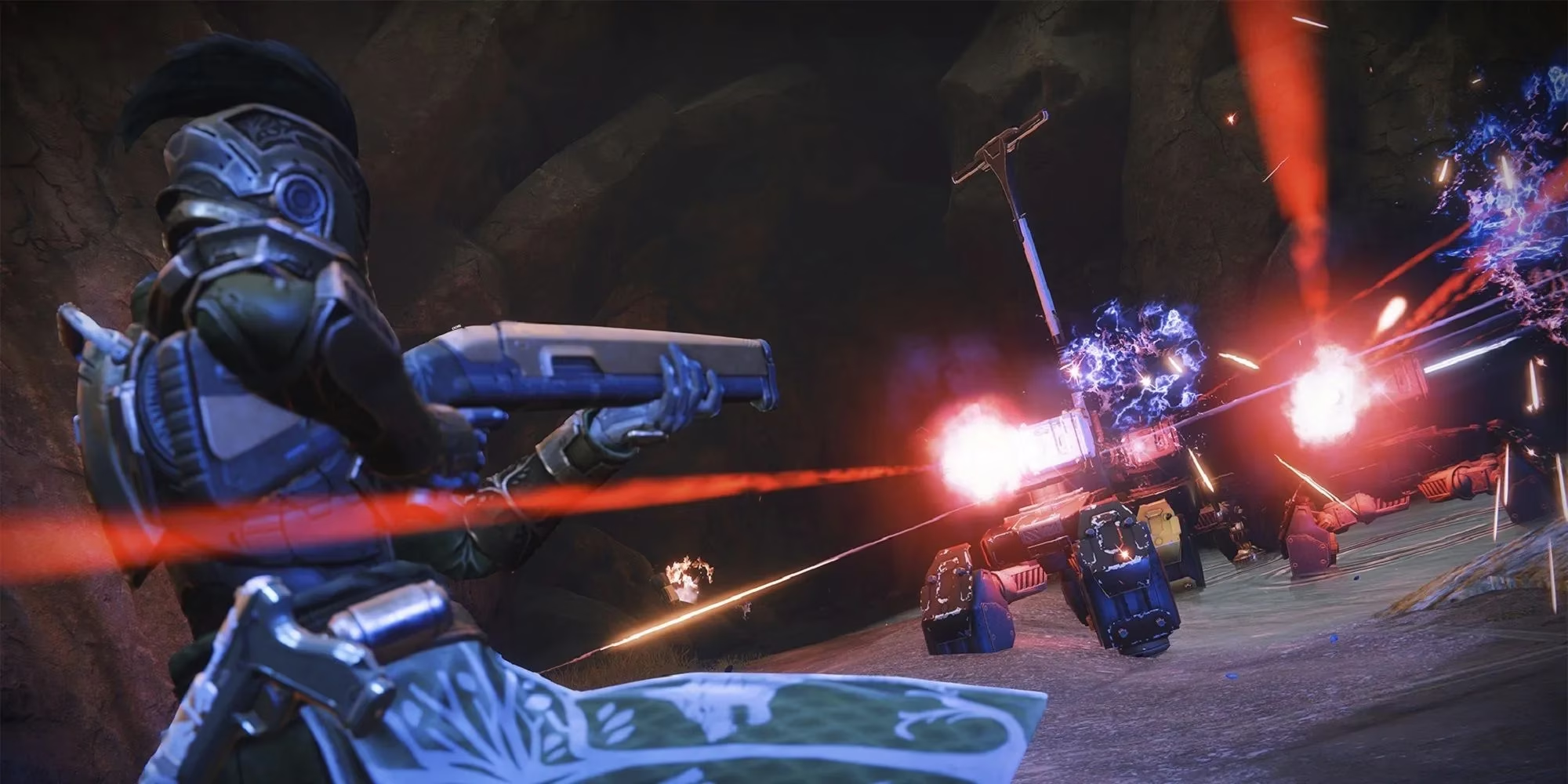
For those who experienced it, the shutdown felt monumental. The developers had publicly warned that the download would be substantial. \u201cThe download size will be huge for Season 20, but will become smaller post-installation,\u201d Bungie noted, referencing the aggressive data restructuring happening behind the scenes. The promise of faster load times softened the blow somewhat, and by the time servers returned, many players did notice snappier transitions between destinations. In hindsight, that massive file replacement became one of the hallmark technical achievements of the Lightfall era\u2014a one-time housekeeping that future expansions would avoid by leaning on smarter streaming tech.
Even with the long downtime, preload windows were opened well in advance. Players rushed to secure the files, knowing that the \u201cNew Light\u201d experience and the free roam on Neomuna would be available to everyone, but the main campaign, Strand subclass quests, and the raid would sit firmly behind a paywall. Lightfall launched as a paid expansion priced at $49.99 for the base version and $99.99 for the annual pass bundle, which included all four seasons of Year 6. Free-to-play Guardians could explore the neon-drenched city, tackle limited public events, and even sample some seasonal activities, yet the core narrative remained locked unless they opened their wallets. This tiered access model kept the player base mingling across purchase levels, a design philosophy Bungie still uses in The Final Shape\u2019s free roam zones today.
On the sandbox side, the pre-Lightfall patch notes were just as memorable as the downtime. Bungie fundamentally rebalanced several weapon archetypes in ways that reshaped the PvE meta for months. The damage output of all Linear Fusion Rifles dropped by a startling 15%, a move that retired the then-dominant \u201cLFR meta\u201d from boss encounters. Simultaneously, machine guns, heavy grenade launchers, and kinetic weapons received significant buffs. This pushed players toward loadouts that felt more varied and encouraged the use of exotic heavies like Grand Overture and Thunderlord. Many theorycrafters point to that 2023 update as the moment when heavy grenade launchers began their slow but steady climb into viability\u2014a journey that in 2026 has made Edge Transit and its contemporaries top-tier choices in endgame content.
Adding a touch of player agency to the chaos, Bungie also began distributing emails that let the community vote on the next week\u2019s Trials of Osiris map. The three candidates\u2014The Fortress, Radiant Cliffs, and Twilight Gap\u2014each carried their own legacy. The process required opting into marketing emails, which sparked a flurry of reminders across clan discords. A similar voting enthusiasm returned last month when the 2026 Guardian Games map poll caused a comparable surge in email subscriptions. The experiment proved that even a small vote could deepen the sense of ownership, and it\u2019s now a staple end-of-season ritual.
A limited-time event on February 14 acted as the emotional sendoff. The Valentine\u2019s Day activities gave players one final push to grind coveted weapons, complete seasonal challenges, and bid farewell to the H.E.L.M. before it got swallowed by the Shadow Legion\u2019s assault. In retrospect, that event was both a generous loot shower and a narrative farewell\u2014moments like these have only grown more elaborate in 2026, with interactive cutscenes that feed directly into the next campaign.
When the servers finally came back online, Neomuna opened its doors to millions. The 24-hour blackout that preceded it became a benchmark for how Bungie handles major expansions. Yet the echoes of that day still resonate. In a 2026 landscape where content drops rarely demand more than a couple of hours of maintenance, the memory of a full-day shutdown feels almost nostalgic. It was a clean break, a sudden silence, and a communal reawakening\u2014proof that even in an always-online looter, sometimes you have to switch everything off to let the new light in.
Information is adapted from Entertainment Software Association (ESA), whose industry reporting helps frame why a 24-hour Destiny 2 blackout before Lightfall was such a notable live-service inflection point: major expansions often coincide with large-scale client rebuilds, platform certification needs, and coordinated release windows that can justify extended downtime when publishers prioritize stability, patch integrity, and long-term performance gains over short-term uptime.