As I log into Destiny 2 in 2026, reflecting on the current state of the game's content delivery, I can't help but feel a sense of déjà vu. We're now several years into the 'Episodic' model that replaced the traditional seasonal structure, and the initial concerns many of us voiced back during The Final Shape and Episode: Echoes era seem to have crystallized into a persistent reality. The promise was a shift towards more substantial, narratively cohesive content blocks spread across the year. Yet, what I experience today often feels like elongated seasons punctuated by awkward, mandated breaks—a structure that, rather than building anticipation, frequently fosters disengagement. Remember the three-week gap after Act 1 of Echoes? That pattern, it seems, was a harbinger of the model's core pacing issue.
The Built-In Void: Content Gaps in the Episodic Era
Has the episodic format truly solved Destiny's perennial content drought problem? From my perspective, the answer is a resounding no. The gaps haven't disappeared; they've simply been repositioned. Under the old seasonal model, we'd receive a complete story arc upfront, with its narrative beats and activities doled out over the first month or so, followed by a longer lull until the next season. Events like Iron Banner or The Dawning served as stopgaps. Now, these pauses are woven directly into the middle of an Episode's narrative. We get a few weeks of story progression, then a hard stop—a 'commercial break,' if you will—before the next act begins. This three-weeks-on, three-weeks-off rhythm can be incredibly jarring. Just as I'm starting to invest in a new plotline or activity, the game effectively tells me to take a hike for a while. Is this really the best way to maintain player engagement week after week? Bungie clearly believes some time-gating is necessary, but this method often feels punitive rather than rewarding.
Quantity vs. Quality: The Unfulfilled Promise
When Episodes were first announced, a key hope was that condensing the year's content from four seasons into three episodes would allow for richer, more developed stories and progression systems. We traded one seasonal release for the promise of deeper, more meaningful content. So, what has the reality been? In my experience, the episodic content often feels stretched thin. The Acts within an Episode can sometimes lack the narrative weight or mechanical innovation to justify their segmented release. We do get new weapons and usually an activity refresh with each Act—that much is true.
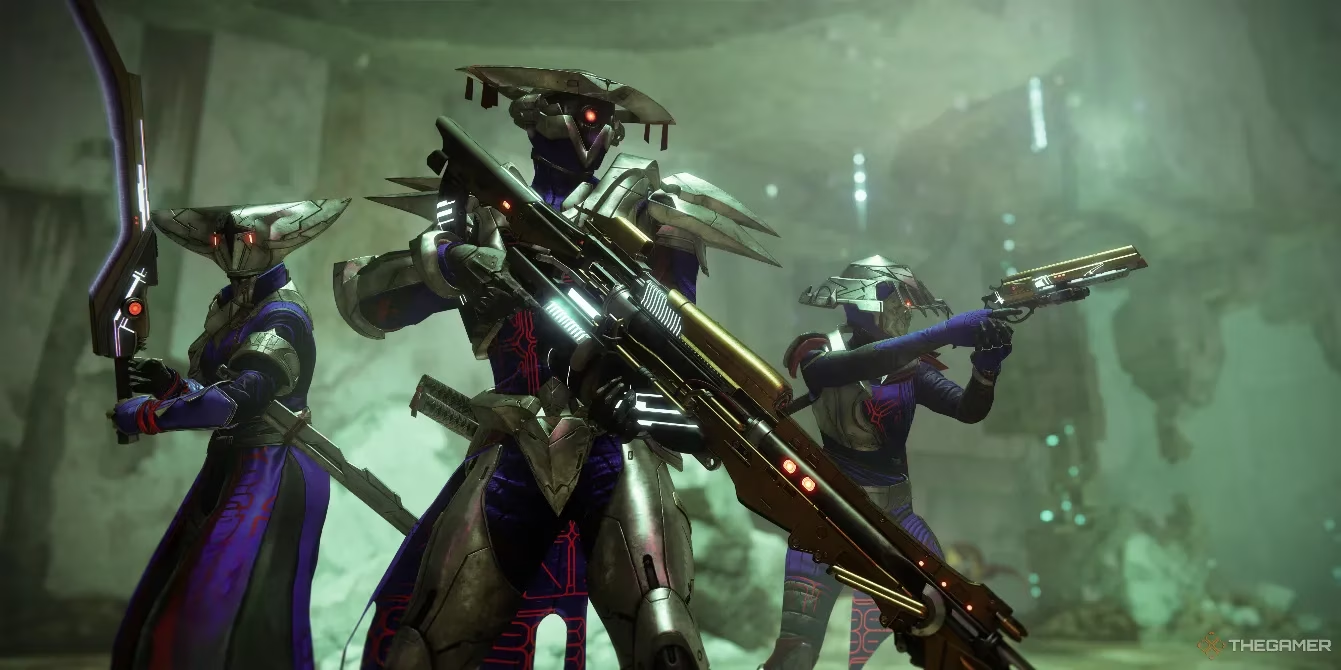
For instance, a typical Episode Act might bring:
-
1-2 New Legendary Weapons 🎯
-
1 New Exotic (weapon or armor) ⭐
-
A reprised or slightly modified seasonal activity 🔄
-
A handful of story missions advancing the plot 📖
While these are welcome additions, they rarely feel substantial enough to carry a three-week period on their own, especially when the subsequent break is just as long. The fear I had back in 2024—that Episodes were just "longer seasons with really weird pacing issues"—has, in many ways, been borne out. The studio may have gained development time for larger annual expansions (like the much-anticipated Frontiers), but the live-service experience during the interim periods has suffered.
The Player Retention Dilemma in 2026
This brings me to the core issue: player retention. Destiny has always struggled to keep players consistently engaged in the weeks following a major expansion. The episodic model, with its built-in breaks, seems to exacerbate this. Why would I, or any player, feel compelled to rush back after a several-week hiatus for what is often just an incremental update? It's one thing to end on a thrilling cliffhanger that leaves the community buzzing with theories. It's another to simply halt the story before it has even found its footing. That initial Echoes break felt like turning off a movie just as the opening credits finished. In today's gaming landscape of 2026, with countless high-quality, player-respectful live-service games and major RPG releases constantly on the horizon, this model feels increasingly archaic. Players have more options than ever, and a game that regularly asks them to leave is a game they might not return to.
A Glimmer of Hope and Necessary Evolution
Am I ready to write off the episodic format completely? Not yet. There have been bright spots. Some Episodes have delivered excellent, self-contained stories with memorable characters. The extended development time has seemingly benefited the annual expansions, making them more polished and feature-rich. Furthermore, Bungie has iterated on the model since its inception. We've seen:
-
Shorter Inter-Act Gaps: Some recent Episodes have reduced the waiting period between acts to two weeks.
-
Enhanced Interlude Events: The gaps are now more frequently filled with meaningful, story-adjacent events or exotic quests, not just standard playlist activities.
-
Better Pacing Within Acts: The content within a single Act is sometimes more densely packed, offering more secrets to uncover and reasons to log in daily.
However, the fundamental tension remains. The community's desire for the option to 'binge' an Episode's story at their own pace clashes with Bungie's design philosophy of stretched engagement. Perhaps the solution isn't abandoning the episodic model, but radically rethinking its cadence. What if Acts were released bi-weekly? What if the narrative was continuous, with the 'gaps' filled by challenging, evergreen endgame pursuits that tie into the ongoing story? The model needs to evolve from feeling like scheduled downtime to feeling like a constantly unfolding, player-driven experience.
Looking at the landscape in 2026, Destiny 2's episodic format stands as a bold but flawed experiment. It aimed to fix the boom-bust cycle of seasons but created a new rhythm of starts and stops that can test even the most dedicated Guardian's patience. The name 'Episodes' turned out to be prophetic—not for cinematic storytelling, but for the constant interruptions. For this model to thrive in the future, it must learn that the best way to keep players tuned in is not to make them change the channel.